
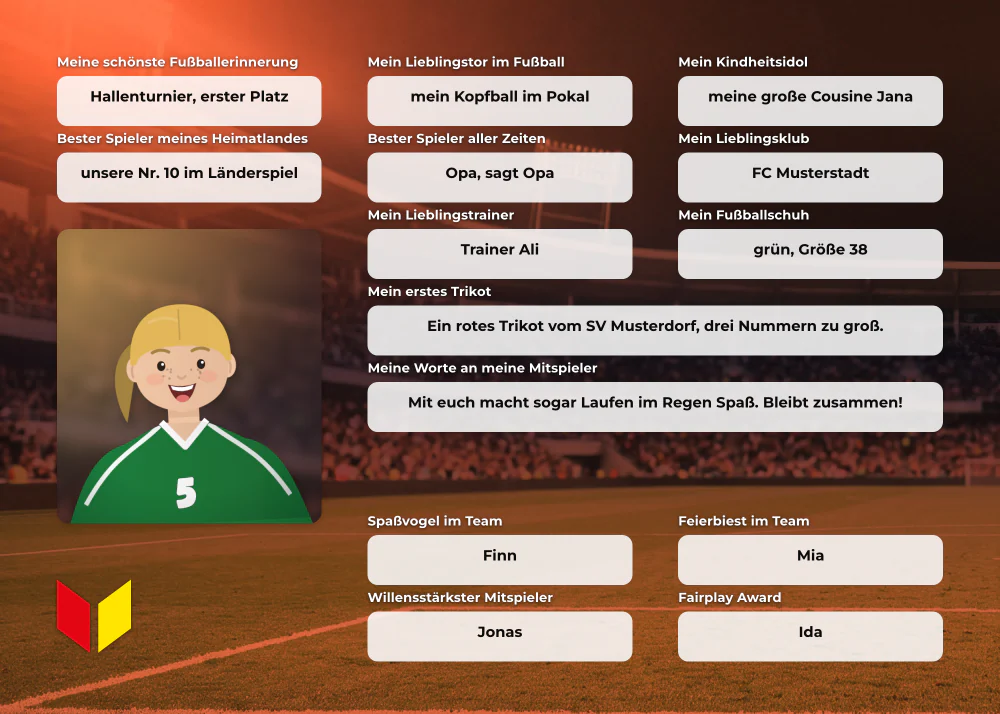
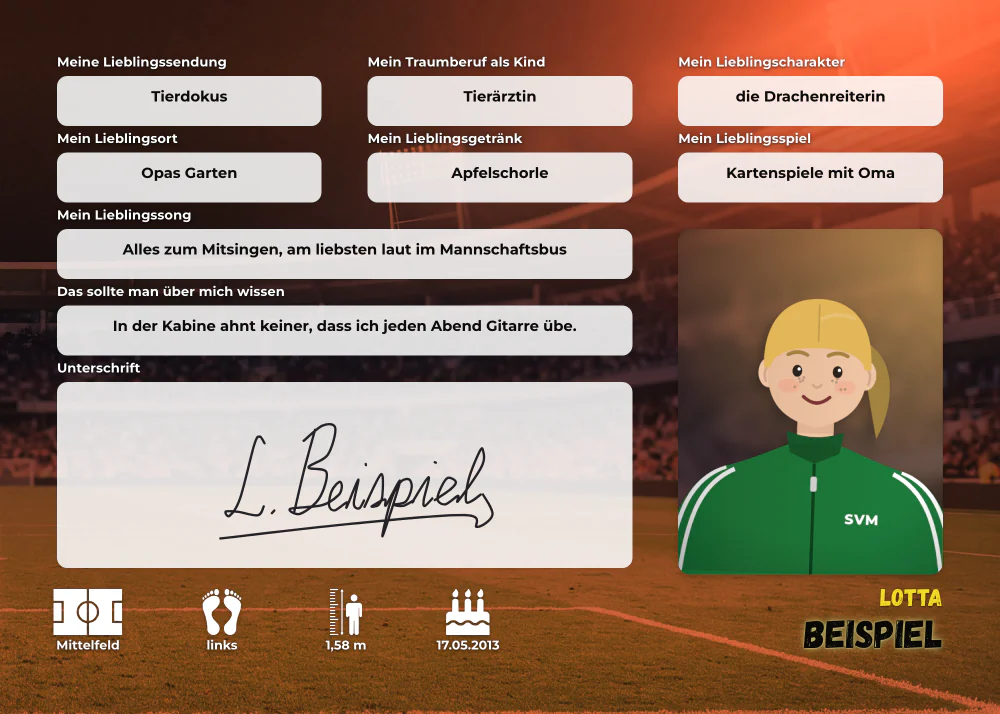
A football player profile introduces a player on a single page: photo, position, stronger foot, role model, best goal. Our football player profile template is a free one-page A4 PDF in German, ready to print and fill in with a ballpoint pen. Below, you'll find which fields are worth including and how your team can use the profiles.
Which fields belong in a player profile?
A good profile has three parts: details you can take in at a glance, a few questions about football and a few about the person behind the shirt. One page is enough, because whatever doesn't fit on it won't get read anyway.
Details at a glance
- First name, surname and nickname
- Club, team, season and shirt number
- Position to tick: goal, defence, midfield, attack
- Stronger foot: left, right or both
- Height in centimetres and birthday
- How long they've been playing football, and their first club
Tick boxes save time and make the profiles easy to compare. For the birthday, the day and month are enough, especially if the profiles will end up on the clubhouse wall.
Questions about football
- Favourite club and role model
- Favourite training drill
- Pre-match ritual
- What I'm really good at
- Why I wear my number
- My best goal or my best save
The question about the best goal has a second half on purpose: goalkeepers write about their best save, defenders about a last-second clearance.
Questions off the pitch
- Favourite post-match food and changing-room song
- Hobbies besides football and dream job
- Best moment with the team
- What I wish us for the season
These questions turn a data sheet into a profile. The wishes for the season are usually what everyone reads out in the end. More questions for teams, classes and friends are in our collection of friendship book questions (the German Freundebuch).
Player profiles by age: from the Bambini to the adult teams
The template works from the age when children can write for themselves. For the very young and for the adults, it's worth adapting a few fields.
Bambini and F-Jugend (under-7s and under-9s). The children talk, the parents write. Fewer fields, and a drawing instead: “Draw yourself taking a shot at goal.” Instead of the position, “I like playing …” is enough, because at this age many children are still trying everything.
E- to C-Jugend (under-11s to under-15s). The template works as it is. Position and stronger foot start to matter, and the questions about role models and changing-room songs get everyone talking.
B-Jugend, adult teams and veterans. Feel free to add more humour. Include fields such as “Best line in the changing room” or “What I look forward to after the final whistle”.
What you can use the profiles for
- Changing-room wall at the start of the season. Everyone fills in a profile at the first training session, and it stays up until the end of the season.
- Introducing new players. A profile says more than a round of introductions, especially for children who are new to the team.
- A quiz at the Christmas party. Someone reads out answers without the names, and the others guess who it is.
- Player portraits. In the match programme or the club newsletter, each issue introduces one person. How to put together a booklet like that is explained in our guide how to make a match programme.
- A farewell keepsake. Collected and bound, the profiles make a gift for the coach.
How to hand out and collect the profiles
Print one copy per person, plus a few extra for latecomers. With children, the sheet goes home and the parents fill it in together with the child. Set a deadline for the next training session and have glue ready for the photos. The photo looks best when it's taken outdoors in daylight, in the team shirt.
Football player profile template: is there a Word version too?
We don't offer a Word file, only the PDF to print, and its fields are in German. If you'd rather fill it in on a computer, or want it in English, the fields are quick to rebuild: a two-column table with the fields from the list above on the left, space for the answers on the right and a frame for the photo at the top. Insert the photos at full size, not as screenshots from a chat, or they'll look blurry in print.
From player profile to team yearbook
In a Flashbook, everyone in the team gets a double-page spread laid out like a big profile: two photos, the answers from the questionnaire, name, signature and four short details with icons. It's filled in on a phone in about 5 minutes rather than on paper, and a hardcover is printed for everyone who orders one. Find out more about the football team yearbook.